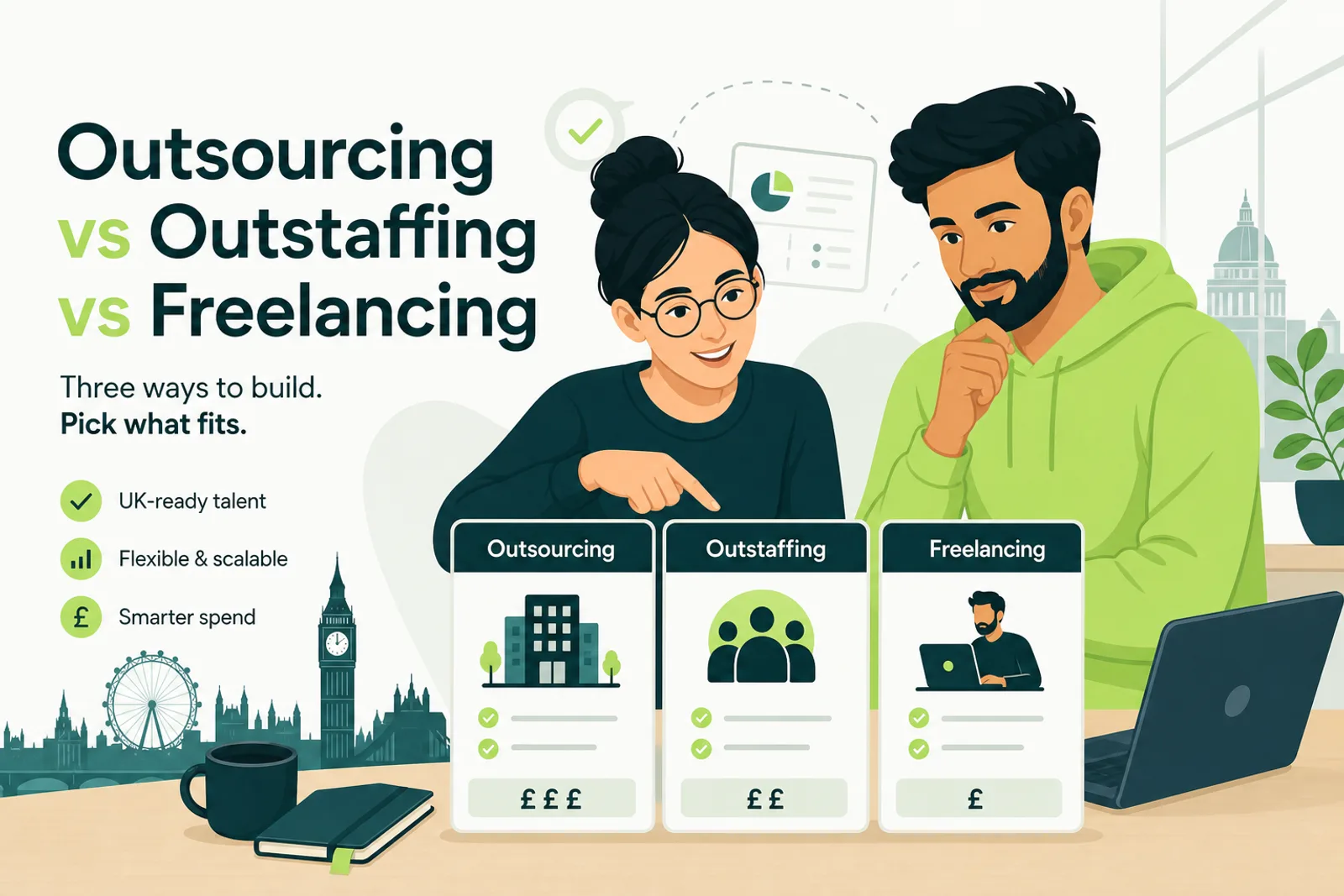
Why UK founders mix these terms up
Founders often ask one question (“what will builders cost?”) and get three different answers depending on whether they mean outsourcing, outstaffing, or freelancing. Those models are not interchangeable. They change who hires people, who owns the backlog, and how painful change requests feel.
This guide is written for UK SaaS teams deciding how to ship a product loop: feedback → roadmap → release. It is original Votiq editorial, not a payments or FX guide. For permanent UK salary and employer on-cost maths, use Cost Breakdown for Affordable UK Tech Talent. For matched builders with ongoing involvement, see Development Support.
Keep reading in this cluster: Cost Breakdown for Affordable UK Tech Tal…, Product Planning Framework for Product Te…, Roadmap Planning Guide, and Development Support.
Outsourcing: you buy an outcome
Outsourcing means a vendor takes a scoped brief and delivers against agreed milestones. Their managers staff the work. You review demos and accept (or reject) deliverables.
Choose it when “done” is crisp: a rebuild with written acceptance tests, a migration checklist, or a one-off integration. Avoid it when weekly customer feedback is still reshaping the roadmap. In that case you are buying change orders, not velocity.
- Vendor employs and manages the people
- You buy a deliverable, not named long-term seats
- Scope changes usually reopen commercial terms
- Fits bounded projects with a clear finish line
Outstaffing: you borrow capacity
Outstaffing (staff augmentation) places dedicated engineers on your product under your prioritisation. The partner handles employment admin. You keep the backlog, rituals, and product decisions.
This is the model most early SaaS teams actually need once an MVP exists: continuity without locking a full permanent payroll on day one. It only works if someone on your side owns priorities every week.
- Named capacity on your roadmap
- Your product owner sets what ships next
- Partner covers employment ops and often replacements
- Fits multi-month product builds with evolving scope
Freelancing: you hire individuals
Freelancing is a direct contract with a person (or a very small collective). Speed is high. Continuity risk is also high. You own briefs, reviews, tooling access, and what happens if someone disappears mid-sprint.
Use freelancers for spikes: payments, performance, a design system pass. Do not use a rotating freelance queue as a substitute for a product team unless you are ready to manage like a studio lead.
- Direct relationship, direct accountability
- Fast start and stop
- Founder-heavy management load
- Fits short specialist work, not standing ownership
How burn usually shows up in each model
Think in cash shape, not a single magic hourly number. Figures below are founder planning heuristics for 2026 UK SaaS teams. Markets move; treat them as order-of-magnitude checks, then get live quotes.
- Outsourced fixed build: often quoted as a project fee for a defined MVP slice (commonly five-figure GBP for a lean first release; six figures when scope, compliance, or integrations expand)
- Outstaffed / dedicated seats: monthly burn per engineer that sits between a contractor day-rate stack and a fully loaded UK permanent seat
- UK freelance product engineers: commonly a few hundred pounds per day; twenty billable days at £500 is about £10k/month before VAT
- Permanent UK mid-level seats: base pay often tens of thousands GBP, with employer NI, pension, kit, and recruiting pushing true year-one cost far above the salary line (detail in our talent cost guide)
Geography changes the invoice, not the management problem
Onshore UK or Western European partners cost more per hour and usually overlap your calendar. Nearshore teams can cut burn while keeping partial overlap. Farther offshore can look cheapest on a rate card and still cost more if feedback loops stretch, requirements stay fuzzy, or rework piles up.
For product work tied to UK customers, overlap and English-language product context often matter more than shaving the last £10/hour. Affordable delivery is shipped software that matches demand, not the lowest CV price.
Contract shapes inside an outsourced build
If you do outsource a slice, pick the commercial shape that matches how clear the work is:
- Project fee with acceptance criteria: good when the MVP is written down; vendors price uncertainty into the quote
- Hours billed as used: flexible when discovery is live; you must watch burn weekly
- Monthly dedicated capacity: steadier for ongoing roadmap work; you pay through quiet weeks too
Side-by-side: control, speed, and risk
A practical comparison for founder decisions:
- Backlog control: outsourcing low · outstaffing high · freelancing high if you manage it
- Time to first commit: freelancing usually fastest · outsourcing and outstaffing need partner onboarding
- Continuity: outsourcing and outstaffing usually stronger · freelancing weakest
- Fuzzy early discovery: outstaffing fits better than a sealed outsourced SOW
- Founder admin load: freelancing highest · outsourcing lowest · outstaffing in between
Costs that do not appear on the rate card
Budgets slip for reasons that never show up in a partner’s brochure:
- Getting outsiders productive on your codebase, access, and compliance checks
- Rewriting work that failed QA or misunderstood the product
- Extra meetings, translators of context, and PM glue across time zones
- Feature creep after the first demo
- Paying overseas suppliers (bank fees and FX spreads if you use international contractors)
- Lost revenue while a delayed release waits on async feedback
Cheap juniors vs expensive rework
A bargain junior rate can still produce the dearest outcome if architecture is weak and seniors spend months untangling it. For SaaS products that must hold customer data and keep shipping, lean toward people senior enough to need less supervision. Pay for judgment, not just keystrokes.
A 90-day decision checklist
Before you sign anything:
- List what must be in users’ hands in 90 days
- Name who owns prioritisation every week
- Decide if you are buying a finished slice or dedicated capacity
- Write a burn ceiling for the quarter
- Prefer outstaffing-style capacity when the roadmap will move with customer feedback
- Prefer a bounded outsourced slice only when acceptance tests are already clear
Where Votiq Development Support fits
Votiq Development Support is for founders who have the idea and need experienced developers and product teams without a hire-and-hope marketplace hand-off. We match talent to stage and goals, and stay involved so delivery stays aimed at real users.
That is closer to product-led outstaffing than a sealed outsourced project. If you already run feedback and roadmap in Votiq, builders can work from voted demand instead of guesswork.
Next step
Write the 90-day outcome, the owner of priorities, and your burn ceiling. Then choose outsourcing, outstaffing, or freelancing on purpose.
Want help matching builders to that plan? Explore Development Support or book a call with your stage, budget, and goals.