Overview
Teams comparing Usersnap and Hotjar usually want clearer signal from the site: what visitors ask for, what breaks, and what to prioritize next. That is a website feedback tool, not heatmaps alone and not a screenshot dump without a backlog.
This commercial page owns website feedback tool, website feedback software, web feedback, and website feedback examples for marketing and product teams. For install and launcher specifics, see the embeddable feedback widget. For logged-in product context, see the in-app feedback widget.
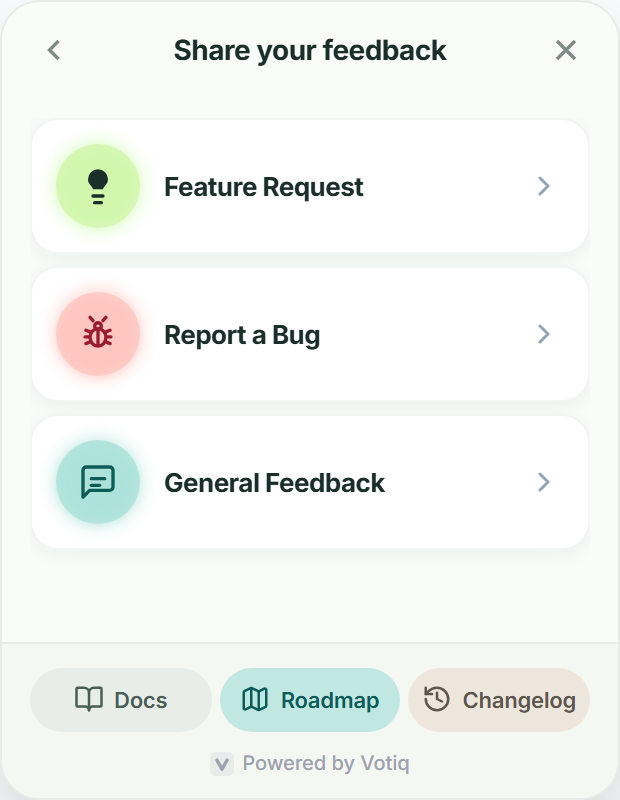
See website feedback tool in the product
Real Votiq screens, not mockups of a different tool.
What is a website feedback tool?
A website feedback tool collects comments, ideas, and bug reports from people on your marketing site or product web experience. Strong website feedback software pairs low-friction intake with a managed backlog marketing and product can triage together.
Without a website feedback tool, web feedback lands in contact forms, chat transcripts, and screenshots nobody owns. With one, every submission has a status, a vote count, and a path to ship.
For placement habits that raise response rates, read website feedback best practices.
Website feedback software and web feedback for marketing + product
Marketing wants clearer conversion and messaging signal. Product wants prioritized requests tied to roadmap work. Website feedback software should serve both without forcing two tools.
Web feedback works when intake is short, categories separate bugs from ideas, and the board is visible enough that visitors vote instead of retyping the same ask. That shared queue is how marketing and product stay aligned on what the site is telling you.
For how website, in-app, and embeddable surfaces differ, read the comparison guide.
Website feedback examples that work
Website feedback examples help teams set expectations for quality and process. Good examples include a pricing-page request with a clear outcome, a docs-page bug with the broken step, and a voted idea that moved from “Under review” to “Shipped” with a changelog link.
Weak examples are vague praise, one-line complaints with no page context, or private email chains marketing cannot share with product. Train visitors with short prompts and visible categories so website feedback examples stay actionable.
Use best practices for placement, then keep a few shipped examples on the portal so newcomers see what good looks like.
Website feedback tool vs Usersnap and Hotjar
Hotjar is strong for heatmaps, recordings, and research surveys. Usersnap is strong for annotated screenshots and visual bug reports. Marketing and product teams still often need website feedback software that turns explicit requests into a voted backlog, roadmap, and release loop.
Votiq is a website feedback tool for that request-and-ship job. Many teams keep behavioral tools for UX diagnosis and use Votiq for web feedback that should become product work. Compare when you need prioritization and public status, not when you only need session replay.
Use the Hotjar compare page for a side-by-side, then validate by collecting one week of real web feedback on your site.
Website vs in-app vs embeddable widget
This page owns the website feedback tool buying intent for marketing and product. The embeddable feedback widget page owns installer and launcher specifics. The in-app feedback widget page owns logged-in product context.
Pick the commercial page that matches how you search. Use the same Votiq project across surfaces when audiences overlap, or split projects when marketing-site visitors and product users need different boards.
The blog comparison walks through the tradeoffs without cannibalizing these commercial terms.
A practical web feedback rhythm
Website feedback software only works if someone owns triage. Use this cadence.
Place the launcher on high-intent pages and link a public board.
Separate bugs from ideas. Route urgent breaks to support; keep ideas on the board with votes.
Triage weekly with marketing and product in the same queue.
Promote winners to the roadmap and ship on Kanban.
Publish a changelog entry and mark related requests shipped.
Start with one marketing page and one product page. Consistency beats a perfect historical backfill.
Why Votiq for marketing and product teams
Choose Votiq when marketing and product want a website feedback tool that doubles as website feedback software without bolting screenshots, boards, and announce tools together. Plans start from £20/mo with a 7-day trial.
Embed the launcher, share the portal, collect a week of web feedback, promote one clear winner, and publish what shipped. That closed loop is the proof website feedback examples can become product outcomes.
Frequently asked questions
Quick answers about how this solution fits SaaS teams evaluating feedback and release tools.
What is a website feedback tool? +
Software marketing and product teams use to collect web feedback from site visitors, organize it in a backlog, and connect it to roadmap and release updates.
What is website feedback software? +
A system for capturing, prioritizing, and closing the loop on website feedback, usually with an on-page launcher, public board, votes, and status.
What counts as good website feedback examples? +
Clear, contextual submissions: the page, the problem or request, and an outcome someone can act on. Strong boards also show shipped examples so visitors know what good looks like.
How is this different from Hotjar or Usersnap? +
Hotjar emphasizes behavior insights. Usersnap emphasizes visual bug capture. Votiq is a website feedback tool for voted requests, roadmap, and changelog. Many teams use them together.
Should I use the website, in-app, or embeddable page? +
Stay here for the website feedback tool buying intent. Use the embeddable feedback widget page for install and launcher details, and the in-app feedback widget page for logged-in product context.